
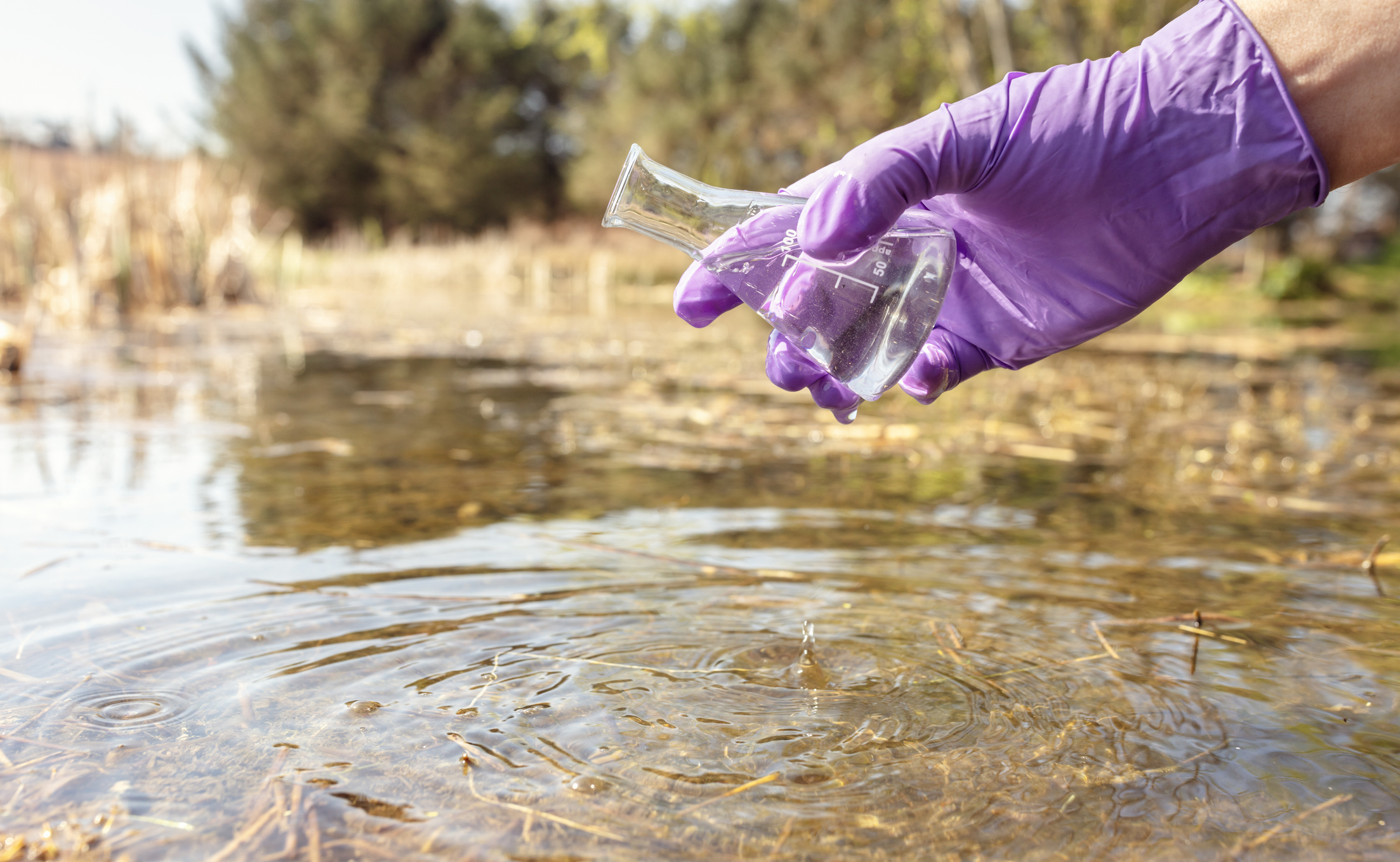







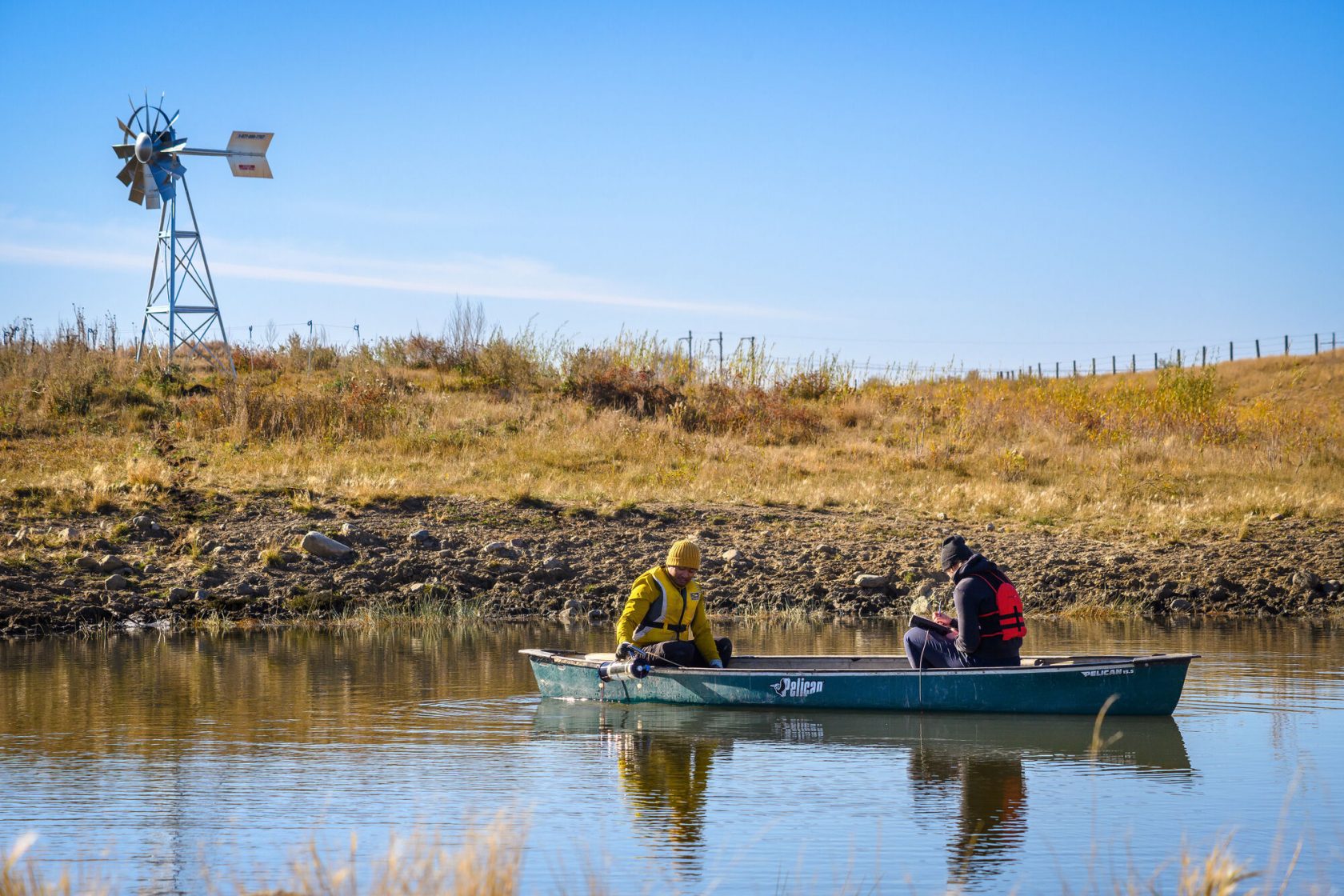
U of R researchers studying dugouts in southern Saskatchewan. (Photo by Trevor Hopkin)
As demands on agricultural production grow and development accelerates, agricultural wetlands are often drained. But, according to a new collaborative study published in FACETS, an international open-access science journal, the cost of wetland drainage on the health of our planet—and on us —may be too high a price to pay.
The research team, which includes academics, farmers, the National Farmers Union, and Ducks Unlimited Canada, examined the Prairie Pothole Region, a stretch of central North America dominated by agriculture and dotted with millions of small, shallow wetlands. Often viewed as an inconvenience on farmland, these wetlands are being drained at a rapid pace to increase productive acreage.
Dr. Kerri Finlay, University of Regina Canada Research Chair in Water in a Changing Environment and director of the Institute for Environmental Change and Society, one of the study’s lead authors, says the team pulled together available data to estimate what wetland loss on agricultural land means for Canada’s agricultural greenhouse gas emissions.

Dr. Kerri Finlay is the U of R Canada Research Chair in Water in a Changing Environment and director of the Institute for Environmental Change and Society. (Photo by Trevor Hopkin)
“Our team found that ongoing wetland drainage in the Canadian portion of the Prairie Pothole Region boosts annual agricultural emissions by at least five per cent,” says Finlay. “The biggest driver is carbon dioxide released when previously submerged wetland sediments are exposed to air after drainage.”
At Canada’s 2024 carbon price, that extra carbon pollution carries a financial cost of $171 million every year.
“While this loss of carbon from the landscape is large and important in itself, it is important to acknowledge that this is part of a broader suite of ecosystem services with value to humans that are lost through wetland drainage activities.”, says Dr. Colin Whitfield, co-author on the work and associate professor at the University of Saskatchewan’s School of Environment and Sustainability.
Other land-use changes linked to wetland drainage, such as reduced diesel fuel used by farm equipment no longer having to navigate around wetlands, did little to counterbalancing the surge of emissions from exposed carbon stores.
“Because these emissions aren’t currently included in Canada’s official National Inventory Report, this represents a significant blind spot in national climate accounting. These values must be added to the inventory and used to shape future policy decisions on Prairie wetland protection,” says Finlay.
The team’s message is clear: these small, overlooked wetlands are doing heavy lifting for the climate, and draining them carries a cost that extends far beyond a farmer’s fence line.
Read the full article here: https://www.facetsjournal.com/doi/10.1139/facets-2025-0124

Improving pandemic preparedness through AI
U of R researcher awarded Canada–France AI grant for stronger outbreak responses
Read More
In the loop
The U of R is at the heart of Saskatchewan’s nuclear future
Read More